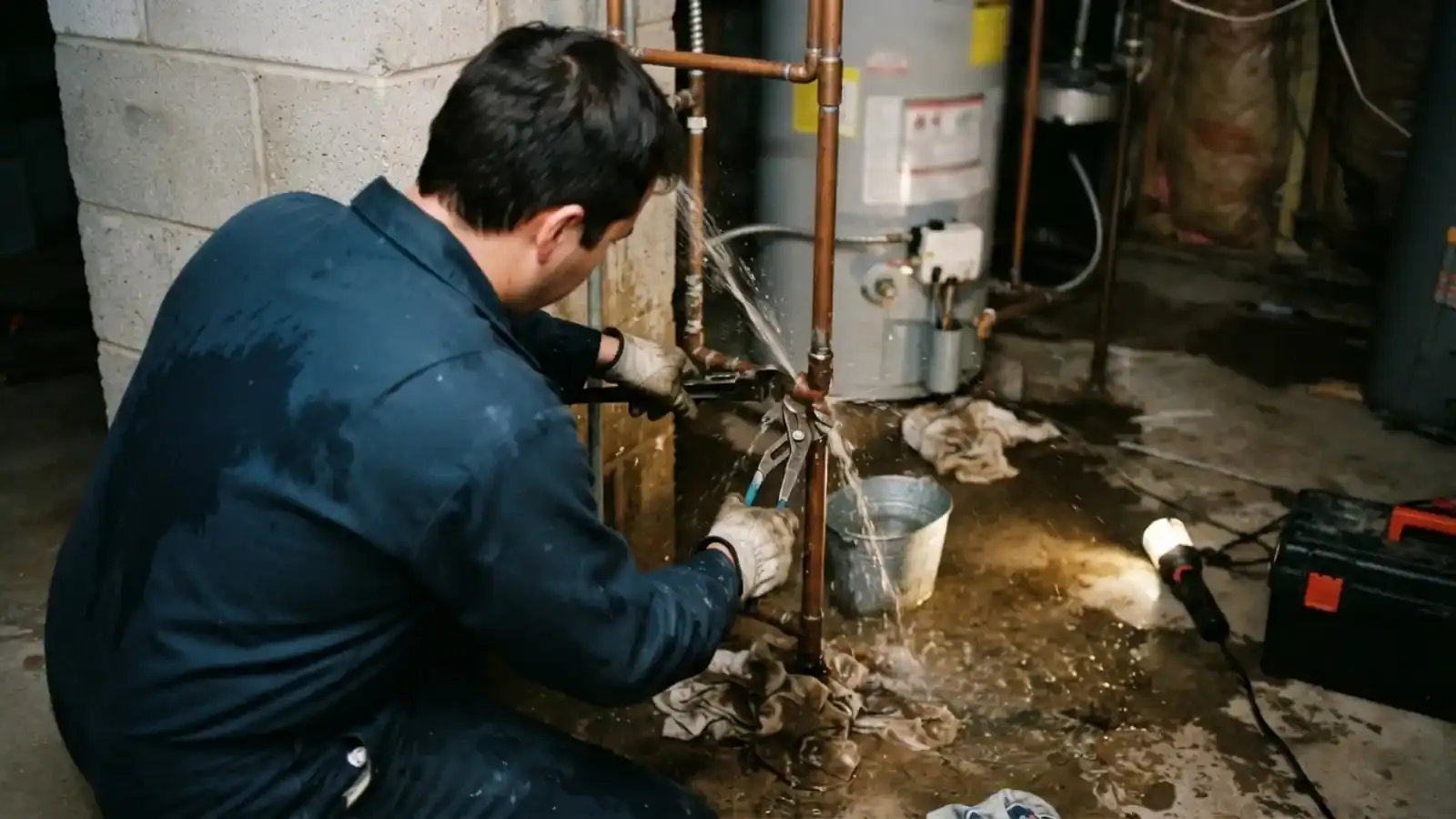
When a pipe bursts: shut it off and protect the house
The main shutoff is the single most useful thing you can find before a plumber gets there. It is usually near where the water line enters the house, in a basement, crawlspace, garage or utility closet, or in the meter box at the street. A quarter-turn lever closes in a quarter turn, while a round wheel handle needs several turns clockwise.
- Close the main shutoff. If you cannot find it or it will not turn, do not force it with a tool, and call us for guidance.
- Open the lowest faucet in the house and the one nearest the break to drain what remains in the pipes.
- Turn off the water heater's power or gas so it does not run dry, and leave it off until the plumber says otherwise.
- If water is reaching outlets, a panel or ceiling lights, switch off those breakers only if you can reach the panel on dry floor.
- Move furniture, rugs and electronics, and scoop or mop standing water to limit damage to flooring.
- Photograph everything, then call (336) 453-0472 and tell the dispatcher what you shut off.
How a cracked or burst pipe shows itself
Not every break is a geyser. Small cracks and split seams can leak for days before they show.
- Water spraying, dripping or pooling with no fixture running.
- A sudden loss of pressure or a faucet that sputters and spits air.
- A wet or sagging ceiling, a bubbling wall or a stain that appears overnight.
- The sound of running water when everything is off.
- A pipe with a visible bulge, split seam or white and green crusting at a joint.
- Soggy ground near the foundation or a meter that keeps turning with the house shut off.
Why pipes crack and burst
Water expands when it freezes, and ice in a pipe builds pressure between the blockage and the closed faucet. The pipe usually splits there, not where the ice formed, which is why a burst can surprise people when the line thaws and water starts to flow. Unheated spaces such as attics, garages, exterior walls and crawlspaces are the common spots.
Freezing is not the only cause. Corrosion thins old metal pipe from the inside until a weak spot gives way, high water pressure strains fittings, and ground movement or a nail through a wall can crack a line. Roots and settling are the usual culprits for broken drain pipe, which fails differently because it does not run under pressure.
Repair options by pipe type
The repair depends on what the pipe is made of and how much of it is damaged. A plumber looks at the break and the pipe on either side before choosing.
| Pipe | How it fails | Usual repair | Trade-off |
|---|---|---|---|
| Copper | Pinholes, freeze splits | Cut out and sweat in new section | Solid fix, needs clean dry pipe. |
| PEX | Split from ice, fitting leaks | Cut and use crimp or expansion fitting | Fast, flexible, damaged runs get replaced. |
| Galvanized steel | Rust-through, thin walls | Replace section or the run | Nearby pipe is often weak too. |
| PVC or ABS drain | Cracks, crushed or root-split | Cut out and glue in new pipe | Needs digging if buried. |
| Cast iron drain | Cracks, rot at joints | Replace section with plastic | Heavy work, tight access. |
Copper pipe repair after a split or pinhole
Copper repair starts by draining the line, drying the pipe and cutting back to metal that is round and sound. The plumber then solders in a new length or uses a push-fit coupling when space is tight and the pipe cannot be fully dried. Soldering holds for decades when done cleanly, while push-fit couplings are fast but cost more per joint.
If a section shows several pinholes, a patch fixes one spot while the rest of the pipe keeps thinning. That is the point where replacing the whole run, or considering repiping, becomes a better value than a string of repairs.
A burst pipe does not wait for business hours, so call (336) 453-0472 now and shut the main while we dispatch.
Broken drain pipe is a different problem
Drain pipe damage rarely floods a room. It shows up as slow drains, gurgling, a sewage smell, a soggy patch in the yard or a dip in a slab. A camera inspection finds the break and shows how much pipe is affected.
Repairing it means opening the floor or yard, replacing the damaged length and backfilling. If the break is on the main line out to the street, see sewer line repair because that work follows different rules and costs.
Patch, section replacement or a new run
A clamp or repair coupling is the fastest way to stop a leak, and sometimes it is the right permanent fix on sound pipe. Replacing a full section costs more upfront but removes the weak spot. Replacing an entire run is justified when the pipe is old, corroded or leaking in several places.
We tell you which category your break falls into and why. If the pipe either side of the split looks brittle, you hear that before any work starts, not afterward.
Frozen pipes: thaw safely, then check for damage
If a pipe is frozen but has not burst, open the faucet it feeds and warm the pipe slowly with a hair dryer or warm towels, starting nearest the faucet. Never use an open flame. If the pipe is bulging, split or already leaking, close the main and call us instead.
Once water flows again, look along the pipe for drips because a split can hide until the ice melts. A house that sits empty, such as a vacation property, should be checked after a cold spell for the same reason. Insulating exposed lines and sealing gaps in unheated areas lowers the odds of a repeat.
What a burst pipe visit looks like
- Stop the waterThe plumber confirms the main is closed, drains the line and makes the area safe.
- Find the full extentThe damaged section is exposed, and the pipe on both sides is checked so a weak neighbor is not missed.
- Explain the priceYou hear the repair options and the price before work starts, including any drywall access.
- Repair and testNew pipe and fittings go in, the line is repressurized and watched for drips before the area is closed up.
What drives the price of a burst pipe repair
A pipe repair is quoted after the plumber sees the break, since two bursts that look alike can need very different work. Same-day appointments are available when scheduling allows, and after-hours calls are dispatched at any time.
- Pipe materialcopper and PEX repair differently and use different fittings.
- Accessa break in an open crawlspace is quick, while one inside a finished wall needs an opening and patching.
- Length of damageone split is a coupling, while several is a new section.
- Water damagedrying, drywall and flooring are separate from the plumbing repair.
- Timingemergency visits at night or on weekends are priced differently from planned work.
After the repair: insurance, permits and drying
Homeowners policies usually cover sudden, accidental water damage but not the burst pipe itself or normal wear, so call your insurer early and keep your photos. Dry wet drywall and flooring within a day or two to avoid mold. Ask the Winston-Salem/Forsyth County Inspections Division at 336-727-2624 whether your repair needs a permit.
Call (336) 453-0472 and we will give you a real number for your situation. We serve Clemmons 27012 and nearby 27023 and 27106, and our Lewisville service page covers calls to the north. Slow leaks that are not yet bursts are a job for leak detection.
Frequently asked questions
Do you handle burst pipe repair emergencies at night or on weekends in Clemmons?
Yes. Dispatch is 24/7 and after-hours calls are answered. The plumber explains the price before work starts. We do not promise an arrival time, but we help you shut the water off and limit damage while you wait.
Where is my main water shutoff?
Look where the water line enters the house, often in a basement, crawlspace, garage or utility closet, or at the meter box near the street. Find it now, before a pipe breaks, and tag it so everyone knows.
Can a burst pipe be repaired without replacing everything?
Often yes. A single split can be cut out and replaced. If the pipe is corroded or has leaked in several places, replacing a whole run saves repeat visits.
Will my homeowners insurance pay for a burst pipe?
Policies usually cover sudden accidental water damage but not the failed pipe or normal wear. Check your policy and call your insurer before cleanup so your photos count.
My pipes froze but nothing burst. What should I do?
Open the faucet it feeds and warm the pipe slowly, starting near the faucet. Skip open flames. Once water flows, check for drips, and call us if you see a split or water stains.
Is a leaking drain pipe the same as a burst pipe?
Not really. Drain pipes do not hold pressure, so they seep or collapse rather than burst. The signs are slow drains, odors and wet ground, and a camera inspection finds the break.
Who supplies water to my Clemmons home?
Check your bill. Some properties use Winston-Salem/Forsyth County Utilities and others use private wells. If the break is before your meter, ask the utility at 336-727-8000. If it is after, call us.
Standards and sources
Burst Pipe Repair work in North Carolina follows the North Carolina State Plumbing Code and the fitting makers' instructions for each repair method. Anyone who does plumbing for hire in the state needs a license under N.C. General Statute 87-21, and the state licensing board runs a public search so you can check a license yourself.
Written by Clemmons 24/7 Plumbing. Questions about permits or inspections go to the Winston-Salem/Forsyth County Inspections Division at 336-727-2624, and questions about the water on the utility side of your meter go to your water provider.