Wet patch in the yard, weak pressure, or a meter that keeps spinning?
When the buried pipe leaks, you usually notice it indirectly: a lawn that stays soft in dry weather, water pooling near the meter, weaker flow at every tap or a bill that climbs. Nothing is visibly broken inside the house, which is why people check fixtures first and lose time.
The pipe behind all of this is the water service line, the single run that feeds the whole house from the meter. Fixing it is a different job from fixing a faucet, and it depends on where the break is and who owns that stretch.
Who owns which side of the meter
Knowing this first saves money. If the leak is on the utility's side, the repair belongs to them. If it is on yours, call us and we will repair it.
Responsibility for the line usually changes somewhere near the meter, but where exactly depends on the provider and the property. Check your bill to see who supplies your water. City and county utility customers can call CityLink at 336-727-8000 to ask who is responsible for your section. Homes on private wells have no utility meter, and the whole line is typically the homeowner's.
When a water service line leak is an emergency
Call right away if water is surfacing in the yard, the driveway is washing out, a basement is taking on water or the house has no water at all. These can be dispatched at night and on weekends, and same-day appointments are available for slower leaks when scheduling allows.
- Find the main shutoff where the line enters the house and close it. Round handles turn clockwise, lever handles turn a quarter turn.
- Do not touch the meter or its valve. They belong to the water provider.
- Open a faucet to drain pressure and check that the water has stopped.
- Keep people and pets off soft or collapsing ground near the leak.
- Photograph the wet area and the meter reading before anything changes.
- Call (336) 453-0472 and tell the dispatcher what you see.
Finding the main shutoff and reading the meter
- Locate the shutoffLook where the line enters the house, often in a basement, crawlspace, garage or utility room. Some homes also have a valve in the meter box.
- Open the meter boxThe box is usually near the street, with a lid you can lift. Stay clear of the meter's own valve.
- Run a leak checkWith all water off, watch the low-flow indicator. If it still moves, close your main and watch again. If it keeps moving, the leak is between the meter and your valve.
- Note what you seeWrite down the reading, the time and any wet spots so the plumber starts with real information.
Low water pressure: service line or something else?
Low pressure at one tap is usually a clogged aerator or valve. Low pressure everywhere often traces back to the service line or a partly closed main valve. A corroded pipe can also narrow inside, which cuts flow without any leak at all.
A simple check helps: attach a pressure gauge to an outdoor spigot and compare readings with the main open and a few taps running. If the pressure is poor with nothing running, the problem is on the street side of the house. A plumber can then test whether the pipe is leaking, narrowed or just regulated too low.
If water is surfacing in the yard or the meter will not stop, call (336) 453-0472 and close your main while we dispatch.
What the symptoms usually point to
These are common patterns, not a diagnosis. We serve 27012, 27023 and 27006, and the dispatcher can talk through your symptoms on the phone.
| What you see | Likely cause | First check | Who handles it |
|---|---|---|---|
| Soggy yard, dry weather | Leak on buried line | Meter test with main closed | Depends on location. |
| Low pressure at every tap | Narrowed or leaking line | Gauge at outdoor spigot | Us, or utility if street side. |
| Meter spins, house is off | Leak before or after valve | Close your main, recheck | Splits the question. |
| Water in the meter box | Fitting at the meter | Look, do not touch valve | Water provider. |
| No water at all | Closed valve or broken line | Check main shutoff | Us. |
How an underground leak is located
Acoustic listening picks up the sound of water escaping the pipe and traces it along the surface. Tracer gas is useful when a leak is too quiet to hear, since the gas rises through soil at the leak. Pressure testing isolates the line and confirms it is losing water.
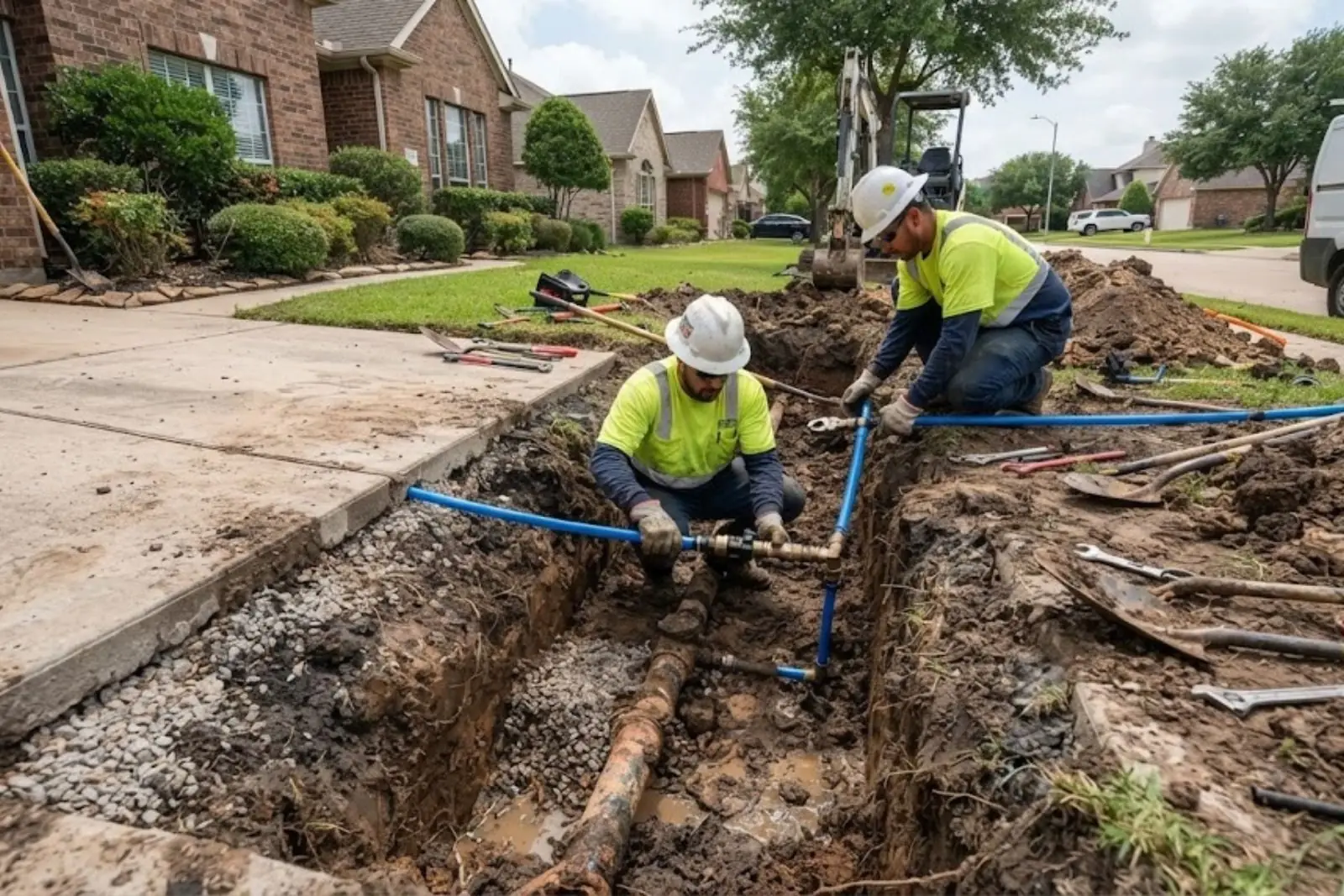
Once the spot is marked, a small excavation exposes it. Marking buried utilities before digging is standard, and we tell you who to call if the dig is near other lines. The aim is the smallest hole that gets the job done. Smaller leaks that are still hidden may need leak detection first.
Spot repair or replace the whole line
Both choices are legitimate. The better one depends on the pipe's condition more than the size of the hole.
| Option | Best when | Upside | Downside |
|---|---|---|---|
| Spot repair | One break, sound pipe nearby | Small dig, quick | Other weak spots may follow. |
| Replace a section | Damage over several feet | Removes the worst length | Bigger trench. |
| Replace full line | Old, corroded or repeated leaks | Ends the repair cycle | More work, higher price. |
| Trenchless methods | Landscaping or drives in the way | Less surface damage | Not suited to every site. |
Homes on a private well work differently
If your water comes from a private well, there is no utility meter and the line from the wellhead or pressure tank to the house is yours. Pressure problems may come from the pump, the pressure tank or the switch rather than the line. We check those first, and we do not give hardness or quality figures for wells, since only a lab test on your own water can.
What affects the price of a service line repair
A service line quote is firm only after the leak is located, so any number given on the phone is a range of what to expect. After-hours calls are dispatched at any time and same-day work is available when schedules allow.
- Depth and lengtha short shallow trench is quicker than a long run under a driveway.
- Surfacelawn, concrete, pavers and landscaping each cost different amounts to restore.
- Pipe typecopper, PEX and plastic lines repair differently.
- Ownershipa leak on the utility's side is theirs to fix.
- Scopea spot repair differs from replacing the full line.
Insurance, permits and next steps
Homeowners policies usually cover sudden accidental water damage but not the failed pipe or normal wear, so read your policy. Some insurers sell separate line coverage. Ask the Winston-Salem/Forsyth County Inspections Division at 336-727-2624 whether the work needs a permit.
Call (336) 453-0472 for your real number. For a break inside the house see burst pipe repair, for northern calls see our Lewisville plumber page, and the service area page lists nearby towns.
Frequently asked questions
Do you handle water service line repair emergencies at night or on weekends in Clemmons?
Yes. Dispatch is 24/7 and after-hours calls are answered. The plumber explains the price before work starts. We do not promise an arrival time, but we help you stop the water and protect the property while you wait.
Why is the grass wet and my meter spinning when nothing is on?
A buried line may be leaking between the meter and the house. Close your main shutoff and watch the meter. If it still moves, the leak is before your valve, and a plumber can locate it.
Who is responsible for the water line from the street to my house in Clemmons?
Ask the water provider. Check your bill to see who supplies your water, and city or county utility customers can call CityLink at 336-727-8000. Private well homes own the whole line.
How do I tell if low pressure is the service line?
If every tap is weak, first confirm your main shutoff is fully open. Then put a gauge on an outdoor spigot. Poor pressure with nothing running points to a leak or a narrowed line, and a plumber can test which.
Do I have to dig up my whole yard?
Usually not. The leak is located first, then the trench opens only where needed. Some sites allow trenchless methods, which we explain on the phone.
Does a leak at the meter box need a plumber?
The meter belongs to the water provider, so call them first. If the problem is a fitting after the meter, we can repair it.
Which ZIP codes do you cover for service line work?
We serve Clemmons 27012 and nearby addresses including 27023, 27006 and 27106. Call (336) 453-0472 to confirm yours.
Standards and sources
Water Service Line Repair work in North Carolina follows the North Carolina State Plumbing Code and the pipe makers' instructions and the water provider's rules at the meter. Anyone who does plumbing for hire in the state needs a license under N.C. General Statute 87-21, and the state licensing board runs a public search so you can check a license yourself.
Written by Clemmons 24/7 Plumbing. Questions about permits or inspections go to the Winston-Salem/Forsyth County Inspections Division at 336-727-2624, and questions about the water on the utility side of your meter go to your water provider.