When a burst supply line or stuck valve is an emergency
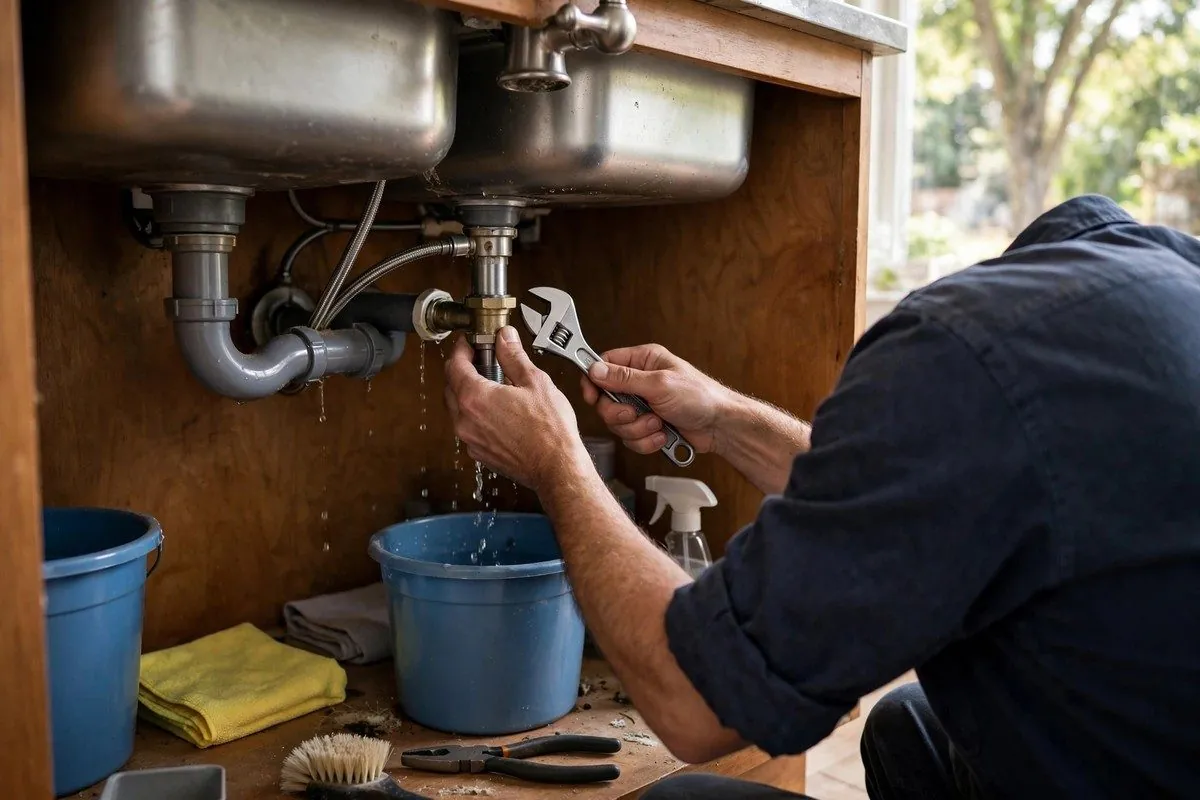
A braided supply line can split without warning, and a sink stop valve that has not been turned in years often refuses to close when you need it. Either one can put a lot of water on a floor in minutes. A fixture that sprays, or a handle that spins without shutting flow, counts the same way. Our Lewisville page has details for callers north of town.
Call us at any hour, since after-hours calls are answered and the plumber gives a clear price before work starts. In the meantime, work through these steps.
- Try the stop valve under the sink first, turning it clockwise by hand. Do not force a valve that is stuck, because a snapped stem makes things worse.
- If the stop valve will not close, shut the main water valve where the line enters the house, often near the water heater or in a basement or crawlspace.
- Open the lowest faucet in the house to relieve pressure and drain the pipes.
- Empty the cabinet and soak up standing water so it does not reach the floor or wall base.
- Switch off power to anything wet, such as a disposal or a nearby outlet, only if you can do that dry.
- Take a photo of the failed line or valve and keep the broken part for the plumber.
Where faucets and fixtures actually fail
Most faucet repairs trace to one of a handful of wear points. Matching the symptom to the part keeps a visit short and keeps you from paying for parts that were fine.
| Symptom | Usual culprit | Typical fix | Replace fixture if |
|---|---|---|---|
| Drip from the spout | Worn cartridge, washer, or seat | Replace the cartridge or seals | Body is corroded or finish is failing. |
| Handle loose or hard to turn | Worn cartridge or mineral buildup | Clean or swap the cartridge | Parts are discontinued. |
| Water at the base of the faucet | Failed O-rings or a cracked body | Replace O-rings | Body is cracked. |
| Low flow from one fixture | Clogged aerator or cartridge debris | Clean aerator, flush the lines | Supply line inside is deteriorated. |
| Water behind the wall at a shower | Valve body or connection leaking | Replace the valve trim or valve | Wall access is needed. |
How a cartridge replacement goes
- Shut off the waterThe plumber closes the stop valve or the main, then opens the faucet to confirm flow has stopped and the line is relieved.
- Take the fixture apartThe handle, trim, and retaining clip come off to expose the cartridge. Corroded stems sometimes need a puller, and that adds time.
- Match and replaceThe old cartridge is matched to the brand and model so the new one seals the same way, then seated with fresh O-rings.
- Test under pressureWater is turned back on slowly, handles are run through hot and cold, and the plumber checks the supply connections for weeping.
Faucet, valve, and fixture repair in practice
Faucet repair is mostly small parts under pressure. A cartridge, a seat, an O-ring, or a supply line wears out, and the fix is replacing it. The trade-off is time against value: an older faucet with a pitted finish and a leaking body costs more in labor to repair than to replace.
Valves deserve more suspicion than they get. The shutoff under a sink, the stop behind a toilet, and the angle stops at an appliance all sit unused for years, then seize when needed. Replacing a stop valve while the plumber is already there is cheap insurance against the next emergency.
We repair what can be repaired and say so when a fixture is better replaced. If you want a different faucet, bring the brand or finish you picked, since fit and hole spacing decide whether it works on your sink or counter. Calls from 27012 and the neighboring ZIP codes 27023 and 27106 are handled the same way, with same-day appointments when available.
Water running where it should not? Call (336) 453-0472 and we will walk you through the shutoff.
Shower valves, showerheads, and bathtub faucets
A showerhead that drips after the water is off is often a worn cartridge or a stuck diverter, not the head itself. A tub spout that sends water through the shower while the tub is running points to the diverter, and a handle that leaks inside the wall needs the valve opened up.
Bathtub faucet repair gets more involved when the valve has no access panel behind it. In that case the plumber may need to cut a small opening in the wall, and the visit includes telling you how that will be handled and who finishes the drywall. Plumbing is our part. Tile and paint are not.
Water stains on the ceiling below a bathroom, or a warm or damp wall next to a shower, deserve a call even if the faucet looks dry. If the stain keeps growing with every fixture off, leak detection can trace where the water enters.
Shower and tub drains that will not clear
Hair and soap form a plug just below the strainer, and a plastic hair catcher with a bent wire often clears it. If water backs up in the tub when another fixture drains, or gurgles in a floor drain, the clog is farther down the line. That job goes to drain cleaning.
Signs a fixture needs attention
- A steady drip that does not stop when the handle is pushed fully closed.
- Water pooling on the cabinet floor or a musty smell under the sink.
- A handle that turns with no change in flow.
- Hot and cold swapped, or a shower that shifts temperature without warning.
- Hissing or knocking in the pipes when a faucet closes.
- A bulging, rusted, or crusted supply line or stop valve.
- A higher water bill with no change in how you use water.
What affects the cost of faucet and valve work
A cartridge swap and a valve replaced inside a wall can both be called faucet repair, but they sit far apart in time and materials. These factors set the number.
- Part typeA standard cartridge or washer is a modest part, while a brand-specific cartridge can be expensive or backordered.
- AccessA sink fixture is open under the counter, while a shower valve may sit behind tile and need wall access.
- Valve conditionStop valves that will not close often need replacing before the real repair can start.
- Fixture ageOlder fixtures sometimes have no parts, so replacing the whole faucet is the sensible choice.
- Time of dayA burst supply line at 2 a.m. is scheduled differently than a drip you can live with until morning.
Homeowners policies usually cover sudden accidental water damage but not the failed part or normal wear, so check your policy and keep photos. Call (336) 453-0472 for your real number, and you get a clear price before work starts.
What to do before we arrive: stop a faucet leak safely
A leaking faucet is rarely dangerous, but water near outlets and cabinets can do damage quickly. These steps keep the problem small until a plumber arrives.
- Turn the angle stop valves under the sink clockwise to shut off the supply to that faucet. If there are none, close the main water valve.
- Do not run the garbage disposal or dishwasher while water is leaking under the sink.
- Empty the cabinet, set a bucket under the leak and put towels down to protect the floor.
- If water has reached an outlet or an appliance cord, switch off that circuit at the breaker before you touch anything.
- Take a photo of the leak and the wet area in case you need it for an insurance claim.
Frequently asked questions
Do you handle faucet and sink repair emergencies at night or on weekends in Clemmons?
Yes. Dispatch is 24/7 and after-hours calls are answered. A burst supply line or a valve that will not shut off gets treated as urgent, and the plumber explains the price before work starts. Arrival time depends on the queue and roads, so we do not promise one.
What do I do if the shutoff valve under my sink will not close?
Close the main water valve for the house, open the lowest faucet to drain the lines, and call. Do not force the stem, since that can snap it.
Can you fix an outdoor spigot that drips or leaks inside the wall?
Yes. A hose bib that drips at the handle usually needs new packing or washer, and one that leaks inside the wall needs a closer look. Disconnect hoses in cold weather.
Is my shower dripping because the showerhead is bad?
Sometimes, but a drip after shutoff more often comes from the cartridge or valve behind the handle. A plumber can tell which in a short visit.
Is it better to repair a faucet or replace it?
Repair when the body is sound and parts are available. Replace when the finish is failing, the body is cracked, or the labor to fix it approaches the cost of a new one.
Why does my faucet have low pressure only on one side?
A clogged aerator, a partly closed stop valve, or cartridge debris is the usual cause. If every fixture is low, the issue is likely upstream.
Is Clemmons water hard enough to wear out faucets quickly?
Winston-Salem/Forsyth County Utilities reports soft water, averaging 17.5 ppm hardness in its 2025 report, so heavy scale is less likely. Check your bill to see who supplies your water, since some properties use private wells.
Standards and sources
Faucet and Sink Repair work in North Carolina follows the North Carolina State Plumbing Code and the faucet maker's parts diagrams and installation sheets. Anyone who does plumbing for hire in the state needs a license under N.C. General Statute 87-21, and the state licensing board runs a public search so you can check a license yourself.
Written by Clemmons 24/7 Plumbing. Questions about permits or inspections go to the Winston-Salem/Forsyth County Inspections Division at 336-727-2624, and questions about the water on the utility side of your meter go to your water provider.