My hot water runs out, or goes cold and then hot again
A shower that fades to lukewarm, then surges hot, is one of the most common complaints on tankless units. The cause is usually a flow or heat exchanger problem, such as scale, a clogged inlet filter or a flow that dips below the unit's minimum. On a tank heater, a similar symptom points at a failing element or sediment.
The technical name for the fix depends on which one it is: a flush and descale, a filter cleaning, a vent or gas correction, or a replacement. The sections below separate them.
How a tankless heater works and what it changes
When you open a hot tap, a flow sensor tells the unit to fire. Water passes through a heat exchanger and leaves at the set temperature. There is no standing reserve, so you get hot water as long as the flow stays inside the unit's range.
The trade-off is that a tankless unit has a ceiling on how much it can heat at once. Two showers and a dishwasher can exceed a smaller unit's capacity, and the shortage shows up as lukewarm water. Compare that with a tank, where the stored volume covers short bursts of heavy use.
Install, repair or flush: which one do you need
Each tankless problem has a different remedy, and picking the wrong one wastes money. Use this guide, then call for confirmation.
| Situation | Usual answer | Why |
|---|---|---|
| Thinking of switching from a tank | Install | Venting, gas line and sizing must be planned. |
| Water goes cold and hot, or output is weak | Flush, then repair if needed | Scale and clogs are the common cause. |
| Error code and no heat | Repair | A sensor, igniter, fan or board may have failed. |
| Reduced flow at every hot tap | Clean the inlet screen | Debris blocks the filter. |
| Leak from the heat exchanger | Replace | A cracked exchanger is not a patch job. |
Minimum flow, sizing and why one tap can fail
Every tankless unit has a minimum flow rate that must pass through before the burner or elements fire. If a faucet is barely open or a low-flow fixture runs below that point, the unit shuts off and water goes cold. Opening a tap a little more usually restores heat, which tells you the unit works but the fixture flow is low.
Sizing also depends on how cold the incoming water is and how many fixtures run at once. We ask about your household's habits before recommending a unit, since an undersized one is the top regret with tankless.
Venting and gas line sizing
Gas tankless units move far more fuel per hour than a standard tank, so the existing gas line is often too small. A larger line or a different meter setup may be needed. Venting is also different: many models use sealed, stainless or plastic vent pipe that terminates through a wall, and the manufacturer's instructions specify the material and length.
Electric tankless units skip the gas and vent but can need a heavy circuit, sometimes more than the panel allows. Ask the Winston-Salem/Forsyth County Inspections Division at 336-727-2624 whether your job needs a permit. For a general look at setups, see our water heater installation page.
Tankless flush and descaling
A flush removes mineral scale from inside the heat exchanger. We close the unit's isolation valves, connect hoses to the service ports, and circulate a descaling solution through the unit with a small pump for a period set by the manufacturer. Then we rinse with clean water, clean the inlet screen, reopen the valves and test the output.
Scale reduces heat transfer, so the burner works harder, the water gets less hot, and error codes can appear. Heavy scale can lead to a repair that a timely flush would have avoided.
The Winston-Salem/Forsyth County Utilities 2025 Water Quality Report lists soft water averaging 17.5 ppm, so utility-fed homes tend to scale slowly. That means a flush may be needed less often, but a tap test and the manufacturer's maintenance schedule still decide. If you use a private well, check your bill or well records, since hardness differs there.
Flushing is maintenance, not a fix for a cracked exchanger or a failed board, and we will tell you if the symptom points elsewhere. See also our notes on water heater repair for parts that do fail.
Hot water fading mid-shower? Call (336) 453-0472 to find out whether it needs a flush, a repair or a different unit.
Inlet filter screen and error codes in general terms
A small mesh screen at the cold inlet catches grit. When it clogs, flow drops at every hot tap. Cleaning it is a short job, and it is one of the first things we check on a weak unit.
Error codes vary by brand, but they usually point to a category: ignition, flame sensing, exhaust or intake blockage, temperature sensor, flow sensor or a condensate drain problem. A code tells us where to look, not always what failed, so we confirm with testing. Repeated resets can mask an underlying fault, so call before trying them more than once.
Switching from a tank: what actually changes
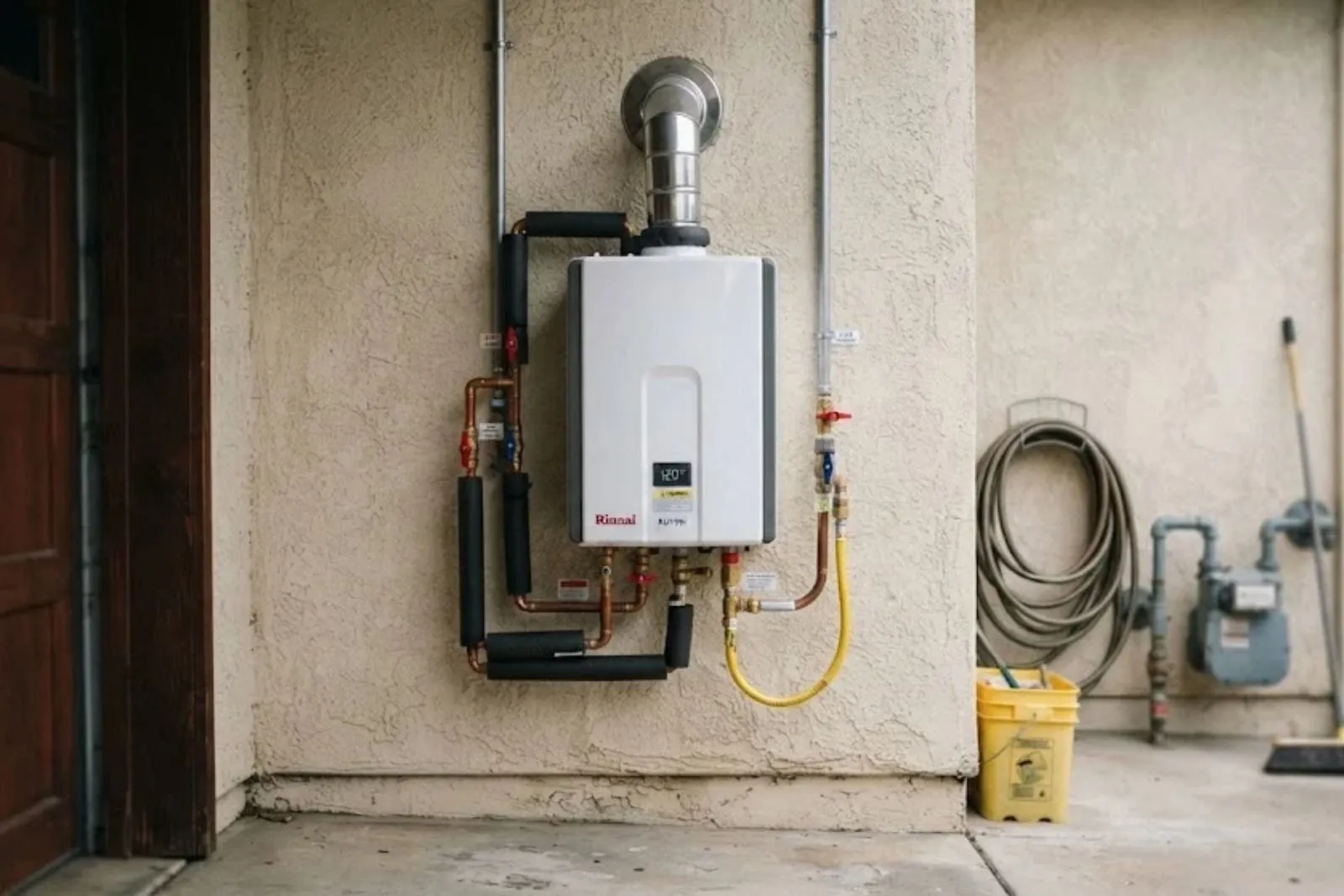
Removing a tank frees floor space, but the wall behind it takes on new hardware. The unit mounts on a wall bracket, isolation valves go on the supply lines for future flushing, and a condensate line may be needed on high-efficiency models. Hot water arrives after a short delay while the burner lights and the pipe fills.
If your current tank has just failed, water heater replacement covers the faster like-for-like path, and a tankless conversion can follow when the venting and gas work are ready. Moving too quickly into a conversion without planning the vent often leads to a second visit.
Signs a tankless heater needs attention
Watch for these:
- Water that fluctuates between hot and cold during a shower.
- A display error code that returns after a reset.
- Weaker hot flow than cold flow at the same fixture.
- Popping, rumbling or whistling from the heat exchanger.
- Visible mineral crust on the inlet filter or valves.
- A burner that starts, shuts off and restarts repeatedly.
What drives tankless pricing
A tankless job has more variables than a tank swap. We give the price before work starts and write down what each part of the scope covers.
- Unit capacity and brandbigger or condensing models cost more up front.
- Gas lineupsizing the pipe or adjusting the meter adds work.
- Ventingsealed vent runs through walls take longer than reusing an old flue.
- Electricala heavy circuit may need a panel upgrade.
- Service typea flush or screen cleaning is far smaller than a new install or exchanger replacement.
Homeowners policies usually cover sudden accidental water damage but not the failed part or normal wear, so check your policy. Call (336) 453-0472 for your real number.
When tankless is not the right choice
A tankless unit costs more to install and can disappoint in homes with many simultaneous showers or very low-flow fixtures. If your gas line, vent path or panel make it costly, we will say so and price a standard tank instead.
Where we serve
We work in Clemmons 27012 and nearby areas including 27023, 27006 and 27104. If you are in the north part of the county, see our Lewisville page.
Safety steps before a tankless heater visit
Tankless units combine gas or electricity with fast, very hot water, so a few steps matter before anyone opens one up.
- Switch off power to the unit and close the gas valve on gas models.
- Note any error code shown on the display, and take a photo of it.
- Do not remove the cover or reset the unit repeatedly, because repeated restarts can hide the original fault.
- If you smell gas, leave the building and call your gas utility or 911 first.
- Keep children and pets away from hot water lines and the vent area.
Frequently asked questions
Why does my shower go cold, then hot, then cold again?
On a tankless unit that usually means scale, a clogged inlet screen or flow dropping below the minimum. A flush and a filter check solve many cases. A tank heater with the same symptom may have a failed element.
How often should a tankless water heater be flushed?
Follow the manufacturer's schedule and adjust for your water. Utility water here is soft, so scale builds slowly, but a tap test is the best guide if you are on a well.
Can you repair a tankless heater showing an error code?
Often yes. The code points to a category such as ignition or sensors, and we test to find the failed part.
Do I need a bigger gas line for a tankless heater?
Frequently, because tankless units demand more gas per hour. The plumber checks the existing line and explains any change.
Is a tankless heater worth the cost?
It depends on household size, fixtures and installation costs. We walk through the trade-offs honestly, including when a tank fits better.
Do I need a permit for a tankless water heater?
Ask the Winston-Salem/Forsyth County Inspections Division at 336-727-2624.
Standards and sources
Tankless Water Heater Service work in North Carolina follows the North Carolina State Plumbing Code and the manufacturer's service manual and error code tables. Anyone who does plumbing for hire in the state needs a license under N.C. General Statute 87-21, and the state licensing board runs a public search so you can check a license yourself.
Written by Clemmons 24/7 Plumbing. Questions about permits or inspections go to the Winston-Salem/Forsyth County Inspections Division at 336-727-2624, and questions about the water on the utility side of your meter go to your water provider.