
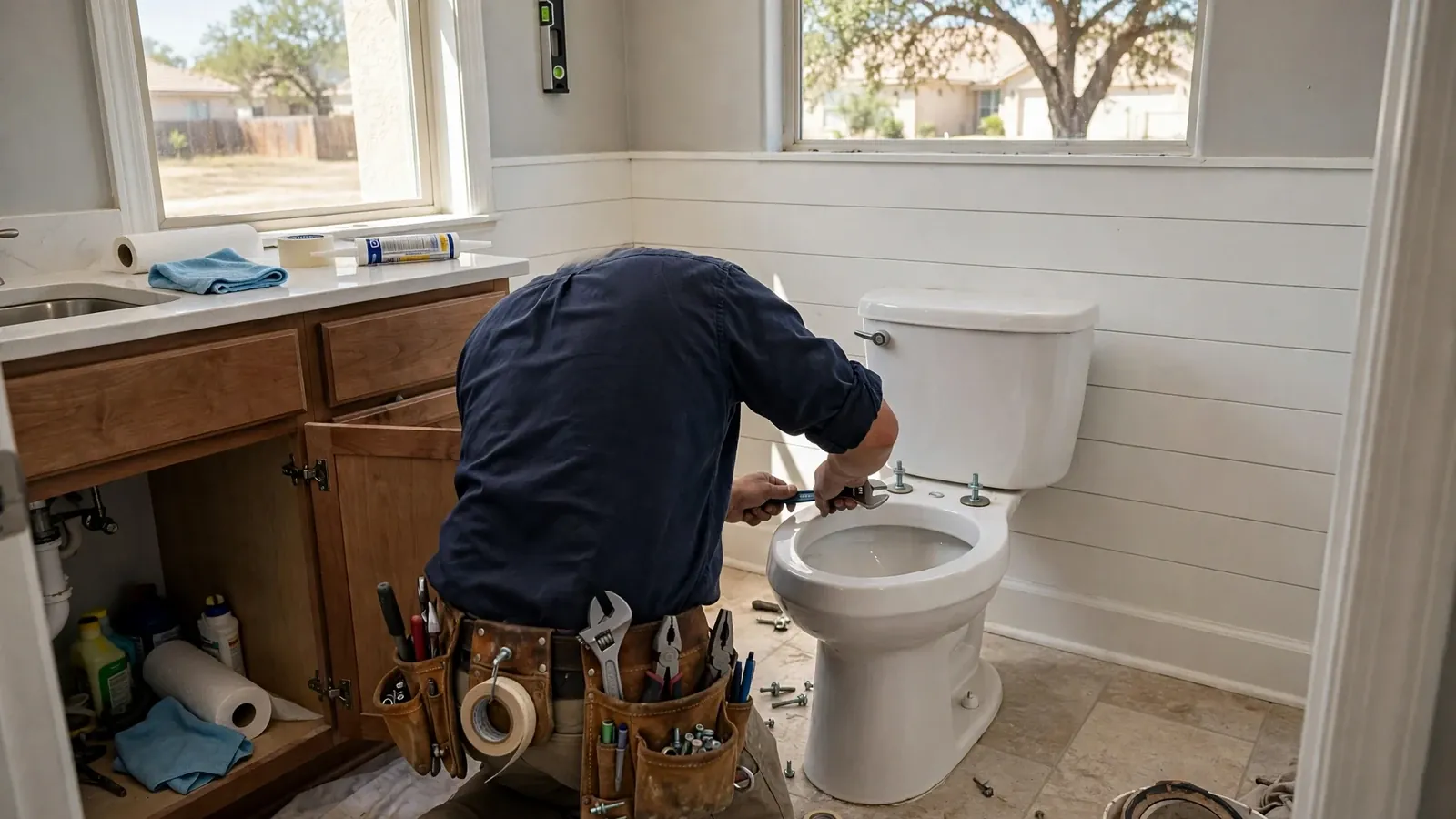
Measure before you buy
Toilets are built to match a rough-in distance. Measure from the finished wall behind the tank (not the baseboard) to the center of the flange bolts. The number decides which models fit.
| Measurement | How to take it | Why it matters |
|---|---|---|
| Rough-in distance | Wall to flange center | Wrong size leaves a gap or pushes the tank into the wall. |
| Flange height | Flange top versus finished floor | Too low causes a weak seal, too high can crack the toilet. |
| Bowl shape and length | Compare to the space in front | Elongated bowls need more room. |
| Supply stop location | Wall or floor, distance from the center | Supply line must reach without kinks. |
The flange: what the toilet bolts to
The closet flange is the ring at the top of the drain pipe that the toilet bolts to. The wax ring seals between the flange and the bottom of the toilet, so the flange should sit level with the finished floor or very slightly above it. When new tile or flooring goes down, the finished floor rises, and a flange that was fine becomes too low.
A cracked, corroded or loose flange is a repair, not a shim job. The material may be plastic, cast iron or brass, and a repair ring or replacement depends on what is there and how it is secured. This is a good moment to call a plumber, since a wrong fix hides until the floor is wet.
Supply stop, wax ring and closet bolts
These small parts decide whether the new toilet holds for years or leaks in a month.
A toilet that is set well should not move at all when you push on the bowl. Any rocking after the nuts are snug is a sign to lift it and look at the flange, floor and bolts again.
- Supply stop (the small valve on the wall or floor) should turn fully on and off without weeping at the stem.
- A stop that is stuck, crusty or leaky should be replaced before the toilet goes in.
- Use a new wax ring or wax-free seal every time. Never reuse an old ring.
- Closet bolts should be the right length and seated in the flange slots, not bent or rusted away.
- Tighten bolt nuts a little at a time on each side, since a cracked bowl cannot be fixed.
- Use a new braided or rigid supply line sized for your stop, not a worn old one.
If the flange looks damaged or the floor feels soft, call (336) 453-0472 before you set a new toilet.
Setting the toilet in five moves
- Shut off water and empty the old unitClose the stop, flush, and sponge out remaining water. Disconnect the supply line and unbolt the toilet from the flange.
- Clean the flange areaScrape off old wax, stuff a rag in the pipe to block sewer gas, and look at the flange and subfloor around it for cracks or soft spots.
- Set bolts and wax ringPlace new bolts in the flange slots, seat the ring on the toilet horn or flange per its instructions, and keep it flat.
- Lower the toilet and press down evenlyLine up the bolt holes, lower straight down, and press with body weight. Do not rock it side to side after it touches wax.
- Tighten, connect and testSnug the nuts evenly, connect the supply, open the stop, and flush several times while checking the base and supply connection for drips.
When the floor under the toilet is the real problem
A toilet that rocks, a floor that gives under your foot, or a dark stain around the base can mean the subfloor is damaged. Slow leaks at a worn seal soak the wood over time. Setting a new toilet on weak wood just moves the leak to a new location.
If the floor is soft, stop before setting anything. A plumber and a carpenter may both be needed, and our plumbing installation visits can tell you what must be fixed in the drain, flange and supply before the fixture goes back.
Septic cautions for a new toilet
Homes on septic should mention it when scheduling work so the plumber knows the system behind the pipe.
A new toilet flushes into the same system. Keep wipes (including ones sold as flushable), paper towels and chemical cleaners out of the bowl. A slow flush after installation points to a setup issue or a drain problem, not a better toilet.
DIY, or call a plumber?
A confident homeowner can swap a like-for-like toilet when the flange, stop and floor are sound. Call a plumber when the flange is damaged, the stop is stuck, the floor is soft, the rough-in does not match any model you like, or you are moving the toilet to a new spot. Moving a toilet involves drain and vent changes that can need a permit.
For the fixture itself, our toilet repair and installation service handles removal, setting and testing. If a dripping line or damp ceiling below the bathroom shows up after a flush, call right away. We serve Clemmons and nearby towns such as Lewisville, and the service area page lists the rest.
Clemmons plumbing note: septic and permits
The Town of Lewisville says many homes in town use septic systems, and its guidance is to have an average system inspected by a professional at least every three years, with tanks typically pumped every three to five years. If your Clemmons-area home is on septic, a new toilet is a good time to ask when the tank was last serviced, since a full tank shows up first as slow flushing at the toilet.
For permits, ask the Winston-Salem/Forsyth County Inspections Division at 336-727-2624 whether your job needs one. It handles plumbing permits for Clemmons and Lewisville.
Source: Town of Lewisville septic guidance and Winston-Salem/Forsyth County Inspections Division.
Frequently asked questions
What is the standard rough-in for a toilet?
Many toilets are built for a common rough-in distance, but homes vary. Measure from the finished wall to the flange bolt center and buy a model that matches your number.
Can I reuse the old wax ring?
No. Once compressed, a wax ring does not reseal reliably. Use a new one or a wax-free seal every time you lift the toilet.
Why does my new toilet rock?
The floor may be uneven or the flange may sit too low or high. Shims can help on small gaps, but a flange problem or soft subfloor needs a repair.
Do I need a permit to replace a toilet?
Ask the Winston-Salem/Forsyth County Inspections Division at 336-727-2624. We do not decide that for you, and the answer can depend on the work.
Does a septic home need anything special for a new toilet?
The toilet is the same, but the system behind it is not. Lewisville's guidance is to inspect septic at least every three years, so mention septic when you call (336) 453-0472.
Standards and sources
This guide was written by Clemmons 24/7 Plumbing using general trade practice and the sources named in the local note above. For code questions, the standard to check is the North Carolina State Plumbing Code together with the manufacturer instructions for your product.
Written by Clemmons 24/7 Plumbing. Questions about permits or inspections go to the Winston-Salem/Forsyth County Inspections Division at 336-727-2624, and questions about the water on the utility side of your meter go to your water provider.