What the inlet screen protects
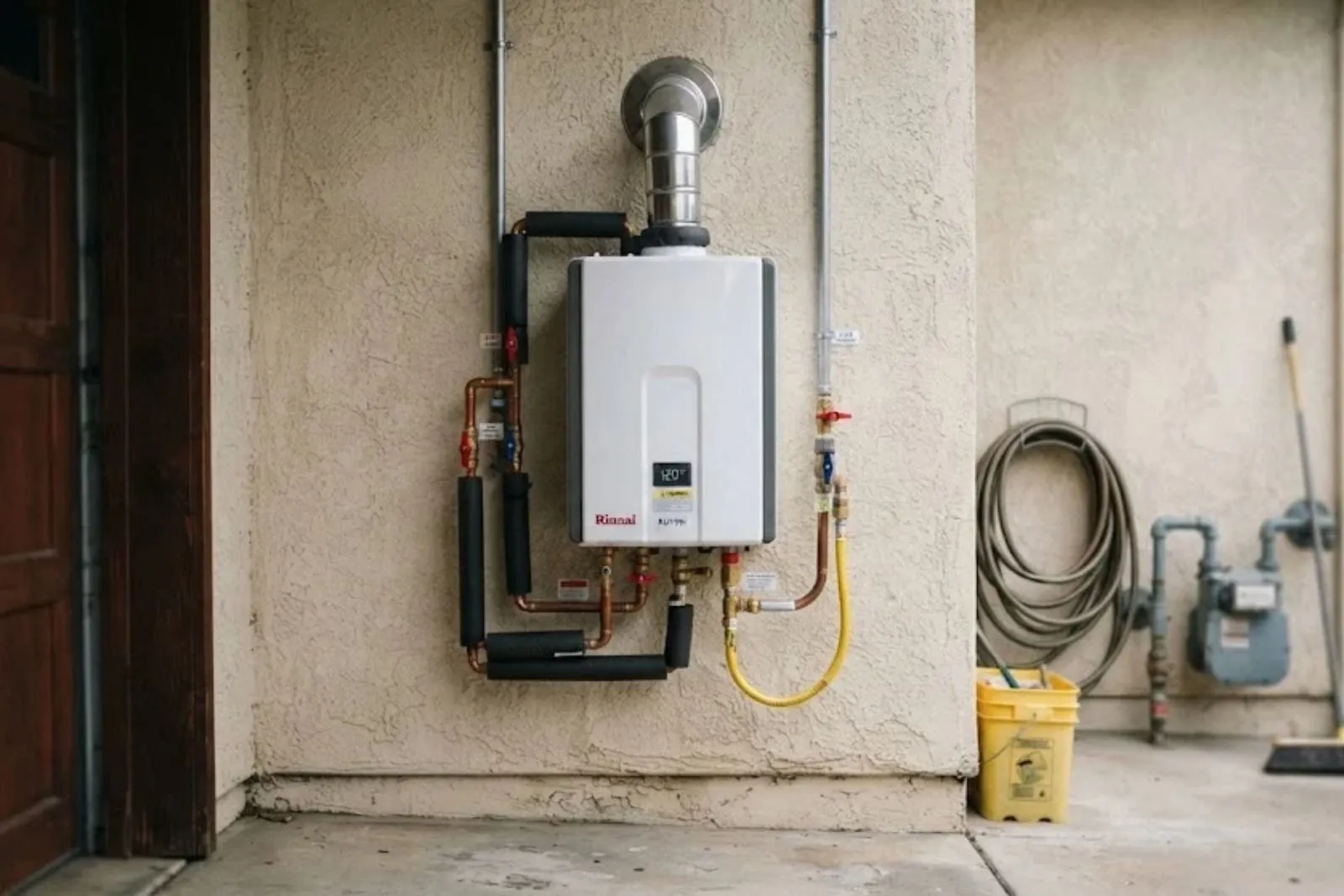
Water passes through the screen before it reaches the flow sensor and the heat exchanger. The sensor tells the unit when to fire. If debris blocks the screen, less water gets through, and the unit may shut down, cycle on and off, or deliver only a trickle of warm water.
Most screens are a fine cylinder or flat mesh behind a threaded cap on the cold inlet. Models differ, so the owner's manual is the guide to where yours sits and how it comes out. Some units also have a separate sediment filter on the supply line, which is a different part with its own schedule.
Signs the screen may be clogged
- Hot water comes out at a weak flow even though other taps run normally.
- Water temperature swings between hot and cool at a steady faucet.
- The unit shows an error code tied to flow or a failed ignition.
- Cold taps in the house have normal pressure while only the hot side is weak.
- Plumbing work, a main shutoff or a utility flush happened recently and loosened debris.
- The unit shuts down shortly after it lights.
How to clean the inlet filter
- Shut everything offTurn off power to the unit, or the gas valve on a gas model, and close the cold water supply valve. Open a hot tap in the house to relieve pressure.
- Open the inlet and catch the waterPlace a bucket and towel under the unit. Slowly loosen the filter cap or housing on the cold inlet. Some water will drain out, so go slowly.
- Rinse and brush the screenPull the mesh out and rinse it under a tap. Use a soft brush to loosen grit. Do not scrape the mesh with metal tools, since a torn screen lets debris through.
- Reinstall and restartSeat the screen, tighten the cap by hand plus a small turn, open the water valve and check for drips. Then restore power or gas and run a hot tap.
Not sure what a clogged inlet screen or a scaled exchanger looks like? Call (336) 453-0472 and describe your unit.
Mistakes that cause bigger problems
Most damage during filter cleaning comes from rushing. A few habits keep a five-minute job from turning into a service call.
- Skipping the shutoff and opening the housing under full pressure, which sprays water over the unit and wall.
- Forgetting the rubber gasket or o-ring, or pinching it when the cap goes back on, which causes a slow drip.
- Reusing a cracked or torn screen instead of getting the right replacement from the manufacturer.
- Cross-threading the cap by forcing it, which can ruin the housing and require a plumber.
- Turning the power or gas back on before the unit is full of water, which can trip errors or damage parts.
- Ignoring a screen that fills with grit again within days, since that points to a larger debris source upstream.
What your water quality means for the schedule
Cleaning frequency depends on what is in the water and what the unit does with it. This table is a rough guide, not a fixed rule. Your manufacturer's maintenance schedule comes first.
| Water condition | Effect on a tankless unit | Check the screen |
|---|---|---|
| Soft water, low minerals | Slower scale on the heat exchanger | Every few months at first, then adjust. |
| Hard water, high minerals | Scale builds faster and can clog the exchanger | More often, plus ask about descaling. |
| Water with sand or sediment | Debris loads the screen quickly | Check after any plumbing work or main flush. |
| Unknown source, private well | Cannot assume anything about hardness | Test your tap, then set a schedule. |
Where the screen stops and a plumber starts
A clean screen does not fix everything. Scale inside the heat exchanger, a failing flow sensor, a cross-connection between hot and cold, or venting trouble on a gas model all need a trained eye. A flushing kit and descaling solution can help in some cases, but they involve isolation valves and hoses that must be set up correctly.
Our tankless water heater service covers installation and diagnosis, and our water heater repair visits handle error codes, sensors and scale. If you smell gas at any point, leave the building and call the gas utility or 911 first.
Descale, repair or replace
If the screen was packed and cleaning restores flow, you are done for now. If flow stays weak, scale on the exchanger is the next suspect. Descaling can restore performance when scale is the only problem. A pattern of repeated clogging, such as a screen that fills with grit again soon after cleaning, is worth reporting so the plumber can look upstream.
Repair makes sense when one part has failed and the rest of the unit is sound. Replacement is worth discussing when the exchanger is damaged or repairs keep coming back. Ask for the cause in plain words and compare written quotes line by line, including parts, labor and any permit work.
We work in Clemmons and nearby towns, including Lewisville, and the service area page shows where else we go.
Clemmons plumbing note: reading your water
Winston-Salem/Forsyth County Utilities draws from the Yadkin River and Salem Lake and reports hardness from 9.0 to 28.0 ppm in its 2025 Water Quality Report, with an average of 17.5 ppm. That is soft water, roughly one grain per gallon, so scale builds slowly on utility-fed homes and the inlet screen often matters more than descaling in the early years.
Check your bill to see who supplies your water, because some properties use private wells. A well can differ from the utility, so test your tap before assuming anything. The utility's water quality line is waterqualityline@cityofws.org for questions about the report.
Source: Winston-Salem/Forsyth County Utilities 2025 Water Quality Report.
Safety steps before you service a tankless heater
Tankless units mix electricity, gas or both with very hot water. Follow the manufacturer instructions and these basics.
- Switch off power to the unit and close the gas valve if it is a gas model.
- Let the water cool before you open any fitting, because it can scald.
- Close both isolation valves and relieve pressure at a hot tap before you remove a screen or filter.
- If you smell gas, leave the building and call your gas utility or 911 before you call a plumber.
- Do not bypass a safety device or run the unit with the covers off.
Frequently asked questions
How often should I clean a tankless heater inlet filter?
Follow the manufacturer's schedule. As a starting point, check it a few months after installation, then adjust based on how much debris you find. Check it any time flow drops.
Is the inlet screen the same as a whole-house sediment filter?
No. The inlet screen is a small mesh inside or at the unit. A sediment filter is a separate canister on the supply line with its own cartridge and schedule.
Can a clogged screen cause lukewarm water?
Yes. Low flow can keep the unit from firing correctly or cause it to cycle. If cleaning does not help, call (336) 453-0472 and a licensed plumber can check scale and sensors.
Do I need a water softener for a tankless heater?
It depends on your water. With soft utility water the need is lower. With a private well or unknown hardness, test the tap first and ask a plumber what the manufacturer recommends.
Is Clemmons water hard on tankless heaters?
The utility's 2025 report shows soft water, 9.0 to 28.0 ppm hardness. Check your bill to confirm your supplier, because well water can differ.
Standards and sources
This guide was written by Clemmons 24/7 Plumbing using general trade practice and the sources named in the local note above. For code questions, the standard to check is the North Carolina State Plumbing Code together with the manufacturer instructions for your product.
Written by Clemmons 24/7 Plumbing. Questions about permits or inspections go to the Winston-Salem/Forsyth County Inspections Division at 336-727-2624, and questions about the water on the utility side of your meter go to your water provider.