Symptom map: what you notice and what it usually means
Start here, then read the section that matches your row.
| Symptom | Usual cause | Try first | Call if |
|---|---|---|---|
| Short blast of cold water between hot cycles | Cold water sandwich | Run a little longer at a steady flow | It happens on every use of one faucet. |
| Hot water fades when one tap is barely open | Flow below the minimum to fire | Open the tap further, clean aerators | Even a fully open tap stays lukewarm. |
| Lukewarm water, lower flow all over | Clogged inlet screen or scale | Clean the screen | Flow stays weak after cleaning. |
| Unit shuts off and shows a code | Ignition, venting or safety fault | Power-cycle once, check the manual | The code returns right away. |
| Popping or rumbling while heating | Scale on the heat exchanger | Schedule a flush | Water is hot but noise is loud. |
The cold water sandwich
You shower, shut the water off for a minute, then turn it back on and get a stretch of cold before the heat returns. The unit shut down when flow stopped, and the pipe between the heater and the fixture still holds the cooled water. The new hot water has to push that cold slug out first.
This is normal behavior for many tankless units and not a defect. Shorter pipe runs and lower-volume fixtures reduce it. A recirculation setup or a small buffer tank can nearly remove it, and a plumber can tell you if your layout suits either.
Minimum flow and the faucet that never gets hot
A tankless heater fires only when enough water moves through it. Every model has a minimum flow, and a tap turned down to a trickle may sit below it. The burner never lights, or it lights and shuts off, and the water stays cool.
Clogged aerators and showerheads can drop flow below that line too. Unscrew them and rinse out the grit before blaming the heater. If the water stays cool even with every tap fully open, the problem is inside the unit, and our tankless water heater service can diagnose it.
Ignition faults, venting trouble and error codes
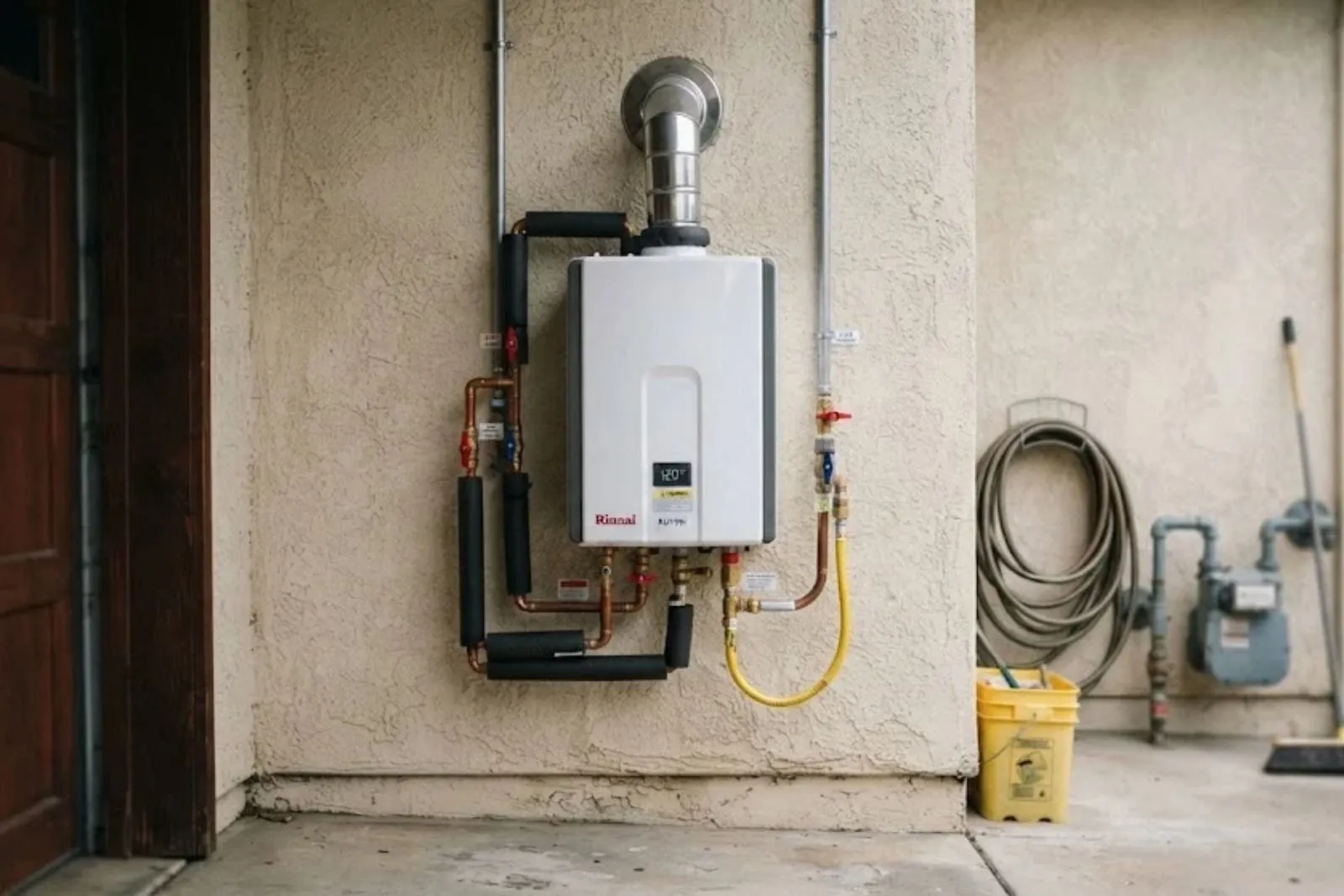
Gas tankless units need air in and exhaust out. A blocked or loose vent, a failed fan, a dirty flame sensor or an interrupted gas supply will make the unit lock out and display a code. Electric units have their own versions, such as a tripped breaker or a failed element.
Codes differ by manufacturer, so the manual is the real reference. In general terms, they fall into groups:
- Ignition or flame codes: the burner did not light or lost its flame.
- Venting or airflow codes: the exhaust is restricted, or the fan is not proving airflow.
- Temperature or limit codes: the water or the exchanger got hotter than the safe limit.
- Flow or sensor codes: the unit cannot read incoming water correctly.
- Scale or exchanger codes: heat is not transferring well.
An error code on a tankless unit points to a specific fault, and call (336) 453-0472 helps you decode it.
Gas smell: leave first
Leave the building and call the gas utility or 911 from outside. Do not flip switches or relight the unit. A plumber can inspect the appliance after the gas company clears the home.
Cleaning the inlet screen
- Shut off water and powerClose the cold water isolation valve and the hot outlet valve if the unit has them. Turn off the power or gas supply as the manual directs.
- Open the filter portPlace a pan underneath, since some water will drain out. Unscrew the cap on the cold water inlet and slide out the small mesh screen.
- Rinse and inspectRinse off grit and mineral flakes under a tap. If the mesh is torn or bent, replace it instead of putting it back.
- Reseat and restartPut the screen and cap back, open the water valves slowly, bleed air at a hot tap, then restore power. Watch for drips at the cap.
Scale, soft water and when to flush
Scale is mineral crust that forms on the heat exchanger when water is heated. It acts like insulation, so the unit works harder, runs hotter and may start to pop or rumble. Harder water builds scale faster, softer water slower.
The right flush interval comes from the manufacturer's instructions, not a guess. Flush earlier if you notice noise, weaker heat or error codes tied to exchanger temperature. The flush uses a pump, a pair of hoses and a descaling solution, and a plumber can do it along with a general water heater repair check.
What to do yourself and when to call
You can handle the first group. Call a licensed plumber for the second, whether you are in Clemmons, Lewisville or elsewhere in our service area:
- Do yourself: clean aerators, clean the inlet screen, and power-cycle the unit once.
- Do yourself: check that the gas valve and water valves are fully open.
- Do yourself: read the code against the manual before calling.
- Call: a code that returns right after reset, or any venting or flame error.
- Call: water that leaks from the unit, or any smell of exhaust indoors.
- Call: scale symptoms when you do not know the last flush date.
Clemmons plumbing note: what the local water report says about scale
The Winston-Salem/Forsyth County Utilities 2025 Water Quality Report lists hardness between 9.0 and 28.0 ppm, averaging 17.5 ppm, which is soft water at roughly one grain per gallon. Check your bill to see who supplies your water, because some properties use private wells, and well water can differ.
If your bill shows this utility, scale should build slowly. Follow the manufacturer's flush schedule and clean the inlet screen when flow drops, instead of flushing more often than the manual calls for.
The same report names chlorine as the disinfectant. Chlorine can leave fine sediment on the inlet screen, one more reason to check it first if the water goes lukewarm.
Source: Winston-Salem/Forsyth County Utilities 2025 Water Quality Report.
Frequently asked questions
Why does my tankless heater give me a burst of cold water in the middle of a shower?
The unit shut off during a pause in flow and the pipe held cooled water. When you restart, that water has to clear before hot water arrives. Running steadily and keeping pauses short helps.
What does an error code on a tankless water heater mean?
Codes differ by maker, but they group into ignition, venting, temperature, flow and scale problems. Check the manual for your code, reset once, and call if it returns.
How do I know if the inlet screen is clogged?
Hot water flow drops across the house and the water may turn lukewarm. Cleaning the screen takes a few minutes and is a safe first step.
Does soft water mean I never need to flush a tankless heater?
No. Soft water slows scale but does not stop it. Follow the manufacturer's instructions for flush timing and ask a plumber if you do not know when it was last done.
Is Clemmons water hard enough to scale a tankless heater quickly?
The county utility's 2025 report lists soft water, with hardness averaging 17.5 ppm, so scale should come slowly on utility water. Private wells can differ, so check your bill to see who supplies your home.
Standards and sources
This guide was written by Clemmons 24/7 Plumbing using general trade practice and the sources named in the local note above. For code questions, the standard to check is the North Carolina State Plumbing Code together with the manufacturer instructions for your product.
Written by Clemmons 24/7 Plumbing. Questions about permits or inspections go to the Winston-Salem/Forsyth County Inspections Division at 336-727-2624, and questions about the water on the utility side of your meter go to your water provider.